

How to Find Inner Peace: 10 Practical Steps to Lasting Calm
There was a period in my twenties when I thought inner peace was something I would finally earn once I had sorted my life out.
Once I knew what I was doing with my career. Once I had more money. Once certain relationships became easier. Once the anxious voice in my head stopped questioning every decision I made.
Peace was always waiting somewhere slightly further down the road.
The problem, of course, was that the road kept moving.
Life has a way of replacing one uncertainty with another. A difficult relationship ends and financial worries appear. Work becomes stable and someone you love gets sick. You finally have a quiet weekend and discover that the noise you were trying to escape has followed you into the room because much of it was never coming from the room in the first place.
This is one reason learning how to find inner peace matters so much now. Gallup’s 2025 global emotional health research, based on more than 145,000 interviews across 144 countries and areas, found that 37% of adults worldwide experienced a lot of stress during the previous day, while 39% experienced a lot of worry.
Our lives may be more technologically connected than at any other point in history, yet the human nervous system is still being asked to absorb uncertainty, comparison, work pressure, notifications, bad news, unfinished conversations and endless demands on its attention.
Waiting for the world to become peaceful first is therefore a poor strategy.
A deeper kind of peace begins somewhere else.
What is inner peace?
Inner peace is a state of internal steadiness in which you can experience thoughts, emotions and difficult circumstances without being continually controlled by them. It does not mean eliminating stress or problems. It means developing enough awareness, acceptance and emotional balance to remain connected to yourself while life moves around you.
That distinction changed my relationship with spiritual practice.
Peace stopped being something fragile that the outside world could give or take away. It became something I could practise.
And practice is exactly what the rest of this guide is about.
Inner peace is not a life without disturbance.
It is the ability to experience thoughts, emotions and difficult circumstances without continually losing your centre to them.
Peace is not the absence of feeling. It is greater freedom in how you respond.
What Is Inner Peace? And What Isn’t It?
Inner peace is sometimes imagined as an almost superhuman state: a serene person sitting beside a mountain stream, untouched by irritation, fear, grief or conflict.
Real life does not look like that.
You can have inner peace and still feel angry. You can grieve and remain grounded. You can be uncertain about your future without being consumed by uncertainty. Someone can upset you without gaining control of the next six hours of your inner life.
Peace is less like making the ocean permanently flat and more like learning how to remain upright when the water moves.
That is a much more useful goal.
The Difference Between Happiness and Inner Peace
Happiness and inner peace overlap, but they are not the same thing.
Happiness often depends on experience. Someone you love walks through the door. You receive good news. Your business succeeds. You sit in the evening sun with nowhere else to be. Something pleasant happens, and your emotional state responds.
Inner peace is deeper.
You may not feel particularly happy while dealing with grief, financial pressure or a difficult decision, yet underneath those emotions there can still be a sense that you are present, capable and fundamentally intact.
Think of happiness as weather.
Inner peace is the ground beneath it.
Weather changes. Sunshine is welcome, but demanding permanent sunshine creates its own kind of suffering.
Inner Peace as Equanimity in Action

Eastern contemplative traditions have long explored the idea of equanimity: meeting pleasant and unpleasant experiences without being dragged helplessly towards one or pushed desperately away from the other.
That does not mean becoming passive.
Quite the opposite.
A regulated person often has more freedom to act because they are not using all their energy fighting their own internal reaction.
Imagine receiving an upsetting message.
In a reactive state, the body tightens, thoughts accelerate and you may respond immediately. Ten minutes later, you regret the words you sent.
With greater equanimity, you still feel the emotional charge. You simply create enough space between the feeling and the behaviour to choose what happens next.
That small space is one of the places where inner mastery begins.
| Aspect | Reactive State | Inner Peace and Equanimity |
|---|---|---|
| Attention | Fixated on the problem | Able to see the wider situation |
| Emotional state | Easily overwhelmed or pulled into rumination | Feels emotion without becoming entirely identified with it |
| Control | Tries to control people, outcomes or uncertainty | Focuses primarily on personal choices and responses |
| Thought pattern | “This should not be happening” | “This is happening. What can I do now?” |
| Behaviour | Immediate reaction | Deliberate response |
| Inner foundation | External conditions determine internal state | Internal practices create greater stability |
This matters physically as well as philosophically. Stress is not merely a thought. It involves the body.
When the brain perceives danger or threat, systems involved in the stress response prepare us for action. Heart rate may rise, muscles tighten and attention narrows. This is extremely useful when genuine danger exists; it becomes exhausting when the body repeatedly reacts to emails, deadlines, memories and imagined futures as though each one requires emergency mobilisation.
Inner peace therefore cannot be built only by thinking peaceful thoughts.
The body must be invited into the process too.
5 Unconscious Beliefs That Can Rob You of Peace
Before adding new meditation techniques or morning rituals, it is worth examining the beliefs that quietly recreate inner tension.
You cannot keep throwing water onto a floor while the tap is still running.
These five appear again and again.
1. “I should be doing something productive.”
Many people have forgotten how to be somewhere without converting the moment into a task.
Rest becomes recovery for more work. Meditation becomes another achievement to track. Walking becomes step-counting. Even holidays acquire itineraries.
I have caught this tendency in myself many times. During difficult periods, I would sit to meditate and notice a subtle impatience beneath the practice: When will this work? How quickly can I become calm?
That is not stillness. It is productivity wearing spiritual clothing.
Sometimes peace starts with allowing ten minutes to have no measurable outcome.
2. “I’ll feel peaceful when my circumstances change.”
This is perhaps the most seductive belief because circumstances genuinely do matter.
A harmful relationship can disturb your wellbeing. Financial instability creates legitimate stress. A chaotic environment affects the body. Inner peace should never be used as an excuse to remain somewhere unhealthy.
But there is another trap: endlessly postponing peace until reality matches your preferences.
When I earn more.
When they apologise.
When I find the right partner.
When my body looks different.
When the house is finished.
Life becomes a waiting room.
Changing your circumstances can be wise. Making inner peace completely dependent upon them leaves you powerless.
3. “Finding inner peace must be difficult.”
Spirituality sometimes makes simple things unnecessarily mysterious.
People imagine they need a perfect meditation cushion, a silent home, a Himalayan retreat or the ability to stop thinking before they can experience stillness.
You do not.
There are moments of peace hiding inside ordinary life: one conscious breath before answering the phone, feeling warm water against your hands while washing a bowl, watching steam rise from tea without simultaneously reaching for your screen.
My mother practised the Japanese tea ceremony when I was growing up, and one of the things I absorbed from watching her was that ordinary movement could contain extraordinary attention.
Nothing dramatic was happening.
That was precisely the point.
4. “I need to control what happens.”
The mind loves certainty.
Unfortunately, life refuses to provide very much of it.
We cannot control another person’s opinion, guarantee that somebody will remain in our life, eliminate every risk or ensure that our plans unfold exactly as expected.
Trying to do so is like gripping water. The harder your hand closes, the less you actually hold.
Inner peace grows when effort becomes more intelligent: act where you have influence, prepare where preparation is possible, then learn to release what was never yours to command.
5. “Difficult emotions mean I’m failing.”
Spiritual practice can become another way to suppress ourselves.
We start believing that an evolved person should never feel jealousy, resentment, rage or fear. So rather than meeting the emotion honestly, we cover it with affirmations and call that peace.
It isn’t.
An emotion does not become dangerous simply because it is uncomfortable. Often the trouble begins when we refuse to feel it, understand it or decide consciously what to do with it.
Peace is not emotional numbness.
It is having enough internal room for the truth.
10 Practical Steps to Find Inner Peace in Daily Life
There is no single technique that creates lasting calm for everyone.
What works better is a collection of small skills: regulating the body, training attention, changing your relationship with thoughts, protecting your energy and learning when to act and when to let go.
Here are ten places to begin.
1. Practise Acceptance Without Becoming Passive
Acceptance is one of the most misunderstood spiritual practices.
It does not mean liking what happened.
It does not mean allowing somebody to mistreat you, abandoning ambition or pretending an injustice is acceptable.
Acceptance simply means ending the argument with the fact that something is already true.
The relationship ended.
The mistake happened.
Someone said what they said.
You cannot change yesterday.
Much of our secondary suffering comes from mentally demanding that reality be different from the reality already in front of us.
Acceptance ≠ Approval
Acceptance means recognising what is already true so you can respond clearly to it.
You can accept that something happened while still:
- setting a boundary
- changing your circumstances
- leaving
- speaking up
- taking action
You stop fighting the fact. You do not stop choosing what comes next.
Try separating a difficult situation into two columns:
Within my control
- how I respond
- what I say next
- where I place my attention
- whether I stay or leave
- what boundary I establish
- the actions I take today
Outside my control
- another person’s thoughts
- the past
- the exact outcome
- other people’s behaviour
- whether everyone understands me
- every possible future event
Then ask a very simple question:
Where am I currently spending most of my energy?
That answer can be revealing.
Peace often returns when energy returns to the part of life where you still have agency.
2. Regulate Your Nervous System Through Slow Breathing
When somebody tells an anxious person to “just relax,” the instruction is almost useless.
The body needs a route back.
Breathing gives us one.
A 2022 systematic review and meta-analysis examined 223 studies suitable for inclusion and found that voluntary slow breathing increased measures of vagally mediated heart-rate variability during breathing, immediately afterwards and following multi-session interventions. These HRV measures are associated with parasympathetic regulation of cardiac function.
An earlier systematic review also found slow breathing was associated with changes in autonomic function alongside reported increases in relaxation and reductions in symptoms of arousal and anxiety, although the authors noted that the evidence base was relatively small.
Ancient traditions did not speak about heart-rate variability, of course. Yogic pranayama, Buddhist breath awareness and Taoist breathing practices developed within completely different explanatory systems.
Yet across centuries, practitioners repeatedly returned to the breath.
What slow breathing research actually shows
Research on slow voluntary breathing has found changes in heart-rate variability associated with parasympathetic regulation, alongside reported improvements in relaxation and reduced arousal.
That does not mean a breathing exercise instantly “resets” every nervous system or treats an anxiety disorder.
What we can reasonably say: slow, comfortable breathing is a practical regulation tool with growing scientific support.
There is wisdom in that.
A Simple Extended-Exhale Practice
Sit comfortably without forcing your posture.
- Allow your jaw and shoulders to soften.
- Breathe gently through your nose if comfortable.
- Inhale for roughly four seconds.
- Exhale slowly for around six seconds.
- Continue for two to five minutes.
Do not turn it into a competition for the longest exhale. The breath should feel smooth rather than strained.
If counting makes you anxious, forget the numbers. Simply let each exhalation become slightly longer and softer than the inhalation.
I often think of this as lowering the flame beneath a boiling pot. You are not ordering the water to become still. You are changing the conditions that keep it agitated.

3. Return Your Attention to the Present Moment
Most mental suffering contains some movement through time.
The mind returns to what happened yesterday and rehearses it again.
Then it jumps forward and creates tomorrow.
Sometimes this is useful. Human beings need memory and planning.
The problem begins when we become unable to come back.
Mindfulness offers that return.
It does not ask you to destroy thought. It asks you to notice where attention has gone and deliberately bring it into contact with what is actually happening now.
This is close to how the Greater Good Science Center at UC Berkeley defines mindfulness: maintaining awareness of our thoughts, feelings, bodily sensations and surroundings while approaching what we notice without judgement. In other words, presence isn’t about forcing the mind into silence; it is about learning to notice experience without immediately becoming entangled in it.
Meditation has moved far beyond monasteries and retreat centres. According to the U.S. National Center for Complementary and Integrative Health, the proportion of American adults reporting meditation use rose from 7.5% in 2002 to 17.3% in 2022—more than doubling in twenty years.
There are good reasons for the interest, but claims should remain grounded. A major JAMA Internal Medicine review examined 47 trials involving 3,515 participants and found moderate evidence that mindfulness meditation programmes produced small to moderate improvements in anxiety and depression compared with nonspecific active controls. It did not find convincing evidence that meditation outperformed other active treatments such as exercise or behavioural therapies.
That is a healthier way to think about meditation.
Not magic.
Not useless.
A practice.
Try the Five-Sense Return
When your mind is racing, quietly notice:
- one thing you can see clearly
- one sound you had previously ignored
- one physical sensation in your body
- the feeling of your feet touching the floor
- one complete breath from beginning to end
You are not trying to make your thoughts disappear.
You are widening the field of awareness so the thoughts are no longer the only thing inside it.
4. Practise Gratitude Without Pretending Everything Is Fine
Gratitude is sometimes presented badly.
If you are grieving, struggling financially or dealing with something painful, being told to “just be grateful” can feel almost insulting.
Healthy gratitude does not deny difficulty.
It allows difficulty and goodness to occupy the same room.
During a period when I was living in a very small apartment in Kyoto and counting almost every yen, I resisted gratitude at first because it seemed dishonest. I was frightened about money. Writing I am abundant in a notebook did not change what was in my bank account.
What helped was becoming more specific.
A bowl of hot miso soup.
A friend who checked in.
Sunlight through the window.
My hands wrapped around a warm cup.
None of those things solved my financial problems. They reminded me that hardship had not swallowed the whole world.
That is an important distinction.
Use the “Three Specific Things” Practice
At the end of the day, write down three things you genuinely appreciated.
Avoid vague entries such as:
I’m grateful for my family.
Go closer:
My brother sent me a ridiculous voice message this morning and made me laugh when I was tense.
Specificity forces attention back into actual experience.
Over time, this can help correct one of the mind’s natural tendencies: treating what is threatening, unfinished or wrong as more urgent than what is already safe and good.
5. Protect Your Peace With Healthy Boundaries and Mono-Tasking
Sometimes the reason you cannot find peace is not that you need another meditation.
You need to say no.
I learned this painfully.
At university I became the person everyone came to when they were falling apart. I thought being endlessly available meant I was compassionate. Someone would arrive upset and I would listen for hours, even when I had work to finish or desperately needed sleep.
Eventually I noticed something uncomfortable.
I was beginning to resent the very people I was trying to help.
For a long time, I felt guilty about that resentment. Later I understood it differently: resentment was information. I was repeatedly abandoning my own limits and then blaming other people for crossing boundaries I had never clearly expressed.
One of the first sentences I practised was painfully simple:
“I care about you, but I don’t have the space for this conversation tonight.”
My hands shook the first few times I said things like that.
Then something miraculous happened.
The world continued.
Boundaries are not the opposite of compassion. They help prevent compassion from turning into self-erasure.
The same principle applies to your attention.
Modern life encourages us to keep twelve mental doors open simultaneously—messages, browser tabs, work, music, television, notifications, half-finished conversations. Then we wonder why silence feels inaccessible.
Try mono-tasking instead.
When you drink tea, drink tea.
When you walk, walk.
When you speak with someone, put the phone down.
When you write, close what you do not need.
This sounds almost absurdly simple. Practised consistently, it can feel radical.
Fragmented attention creates fragmented experience.
Peace needs somewhere to land.
6. Build a Mindfulness Meditation Practice You Can Actually Maintain
You do not need to meditate for an hour each morning.
In fact, making the practice too ambitious is one of the easiest ways to abandon it.
Meditation doesn’t need to be complicated to be useful. The Mayo Clinic notes that even a few minutes of meditation can help restore calm and inner peace, and that the practice can be used almost anywhere — from a quiet room to a walk or even a commute.
Start with five minutes.
Sit somewhere reasonably comfortable. Notice the breath. When thoughts appear—and they will—recognise that thinking has happened and return to breathing.
You might do this fifty times.
That is not fifty failures.
Those fifty returns are the practice.
When I first encountered meditation around Zen temples near Kyoto, I misunderstood experienced practitioners. Their stillness looked effortless from the outside, so I assumed the goal was eventually to have an empty mind.
Years later, I understood that stillness does not require emptiness.
Picture a clear sky.
Thoughts pass through it like birds, weather, smoke and aircraft. Some are beautiful. Some are loud. Occasionally a storm fills everything you can see.
Yet the sky does not chase any of them.
Awareness can develop a similar quality.
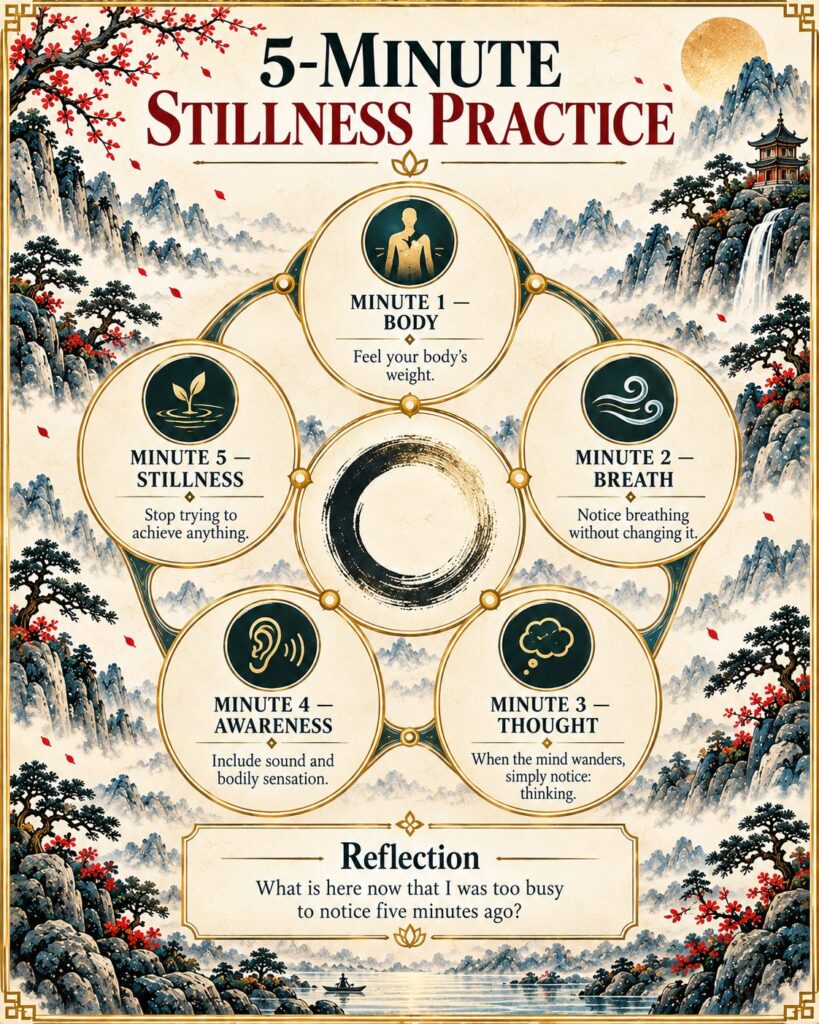
A Simple Five-Minute Meditation
Minute 1: Feel the physical weight of your body.
Minute 2: Notice breathing without changing it.
Minute 3: When thoughts arise, label them gently as thinking.
Minute 4: Expand awareness to sound and bodily sensation.
Minute 5: Sit without trying to achieve anything.
Finish by asking:
What is here now that I was too busy to notice five minutes ago?
One final point matters here. Meditation is often presented online as universally calming, but that is too simplistic. NCCIH notes that a 2020 review of 83 studies involving 6,703 participants estimated that around 8% experienced a negative effect associated with meditation, with anxiety and depression among the most commonly reported experiences.
For most people, gentle mindfulness practices carry few risks, but more intensive practice can sometimes surface difficult memories or emotions. If meditation repeatedly makes you significantly more distressed, stop forcing it. A qualified mental-health professional or experienced trauma-informed teacher may be more appropriate than trying to meditate your way through severe distress alone.
7. Stop Running From the Parts of Yourself That Still Hurt
Silence has an uncomfortable habit.
Eventually, it introduces you to yourself.
This is why some people become restless the moment external stimulation disappears. When the phone is down and the television stops, unresolved grief, shame, anger, loneliness or memories can suddenly become much easier to hear.
That does not mean meditation caused the wound.
The room simply became quiet enough for you to notice what was already inside it.
There was a period of my life when I believed being spiritual meant remaining gentle regardless of what happened around me. I became skilled at appearing calm while swallowing anger. From the outside, that probably looked like peace.
Inside, it felt like pressure building behind a closed door.
Real inner peace required something less elegant: admitting that I was hurt.
Some wounds can be explored through journalling, contemplation, meditation, trusted relationships and compassionate self-reflection. Others—particularly trauma, persistent depression, overwhelming anxiety or experiences that interfere substantially with daily life—may require professional support.
If past experiences still leave you struggling with intrusive memories, anxiety, emotional numbness or a persistent sense of being unsafe, it can help to understand how emotional and psychological trauma can continue affecting both mind and body. Recognising those patterns is not about attaching a label to every painful experience; it can help you understand when self-guided practices are enough and when deeper support may be appropriate.
There is no spiritual failure in that.
Worldwide, anxiety disorders affected an estimated 470 million people in 2023, according to the World Health Organization, yet only about 27.6% of people needing treatment received any treatment.
Spiritual practice can support healing.
It should not become an excuse to avoid it.
8. Release Resentment Without Excusing What Happened
Holding resentment can create the strange experience of allowing someone who hurt you years ago to continue occupying your nervous system today.
They are no longer in the room.
The argument is.
You replay what they said. Imagine what you should have said. Construct better endings. Reopen the trial and present the evidence again.
The mind keeps returning because it wants resolution.
Unfortunately, the past is a courtroom where the defendant rarely arrives.
Forgiveness, when appropriate, does not require pretending the behaviour was acceptable. It does not require reconciliation. You can forgive somebody and never allow them close to you again.
Sometimes forgiveness simply means:
I refuse to continue injuring myself with this memory every day.
There is another form of forgiveness that may be even harder.
Forgiving yourself.
For staying too long.
For ignoring what you knew.
For making the wrong choice.
For who you were when you did not yet know what you know today.
When those memories appear, try replacing the internal prosecution with curiosity:
What was I trying to protect, receive or avoid at that time?
Understanding does not erase responsibility.
It makes integration possible.
9. Spend Time in Nature Without Turning It Into Content
Walk somewhere and do not photograph it.
That suggestion sounds almost rebellious now.
Leave the headphones out for part of the walk. Notice temperature, distance, colour, air, birds, movement. Let your eyes focus beyond the usual arm’s-length world of screens.
Humans have spent almost our entire evolutionary history surrounded by natural environments, while the permanently connected digital world is extraordinarily recent.
Research into nature exposure is still developing, and it should not be exaggerated. A 2020 systematic review of 12 studies found lower physiological stress markers in all seven studies that measured them, while five of six studies measuring perceived stress found lower self-reported stress with greater nature exposure.
A newer 2024 systematic review of eight randomized trials was more cautious, concluding that evidence remained limited for recommending nature-based interventions as a primary treatment for stress, anxiety or depression.
That nuance matters.
You do not need to believe that forests cure anxiety to recognise what twenty minutes among trees can offer: fewer demands, wider visual space, movement, sensory contact and a temporary interruption to the machinery of everyday life.
Nature does not ask you to optimise yourself.
Sometimes that is medicine enough.
10. Move From Powerlessness to Personal Responsibility
This final step needs care.
People experience circumstances they did not choose. Trauma happens. Other people cause harm. Illness, loss, inequality and random misfortune are real.
Personal responsibility does not mean pretending you caused everything that happened to you.
It means refusing to surrender ownership of what happens inside you next.
There is a profound difference between:
“Everything happens to me because something is wrong with me.”
and:
“This happened. I did not choose all of it. But I still have choices now.”
One collapses agency.
The other restores it.
Sometimes the story itself also needs examining. Psychology calls inaccurate or exaggerated interpretations of events cognitive distortions, and learning to challenge them through cognitive restructuring can help create a more balanced view of what has happened.
This does not mean forcing yourself to “think positively.” It means asking whether the thought running through your mind is completely true, partly true, or an interpretation you have repeated so often that it now feels like fact.
Whenever you notice yourself trapped in the same mental story, ask three questions:
- What part of this situation cannot be changed?
- What part can still be influenced?
- What is one action available to me today?
The action might be making a phone call.
Leaving the room.
Going to therapy.
Deleting a number.
Taking a walk.
Apologising.
Getting eight hours of sleep before deciding anything.
Sitting still for three minutes instead of sending the message your anger wants to send.
Inner power rarely arrives with thunder.
Very often, it returns through one small choice.
3 Quick Practices for Finding Calm When Stress Suddenly Spikes

Long-term inner peace takes practice, but sometimes you need something you can use in the next sixty seconds.
These are three of my favourites.
1. The 60-Second Tension Release
Stress can become so normal that we stop noticing how much of it we are physically holding.
Try this:
Clench your fists gently for five seconds.
Release them.
Raise your shoulders towards your ears for five seconds.
Release.
Tighten your legs for five seconds.
Release.
Then take one slow breath and notice the contrast.
The important part is not the tension.
It is recognising what relaxation actually feels like again.
2. Widen Your Vision
Stress narrows attention.
So deliberately widen it.
Look away from your phone or computer and find the furthest object you can see. Without staring intensely at anything, become aware of the edges of your visual field.
Let your gaze become soft.
Then take three unhurried breaths.
You are giving the nervous system new information: there is more to this moment than the problem directly in front of you.
3. Find the Space Between Things
This practice has become one of the quiet foundations of my day.
Notice the tiny pauses life usually rushes through.
The moment after breathing out but before breathing in.
The few seconds after parking the car before opening the door.
The silence after someone finishes speaking.
The space after completing one task before starting another.
Do not fill every gap.
Stay there for a moment.
Much of what we call peace has been present in these spaces all along.
We were simply moving too quickly to meet it.
Inner peace is not a state you permanently achieve.
Some days the mind is quiet. Other days it is crowded.
The practice is the return.
Return to the breath.
Return to the body.
Return to what is here.
Inner Peace Is Something You Return To
Perhaps the most damaging idea about inner peace is that one day you finally “achieve” it.
You become calm enough, healed enough, disciplined enough or spiritually evolved enough, and disturbance never returns.
I have never met anyone whose life works that way.
Practice for long enough and you may become less easily shaken. You may recognise your patterns earlier. Anger may pass through more cleanly. Anxiety may no longer control as many decisions. You learn which battles deserve your energy and which are invitations to put the sword down.
But you will still be human.
Some mornings your mind will be clear.
Others will be crowded.
The practice is the return.
Return to your breath.
Return to the body.
Return to what is actually happening rather than every story the mind has built around it.
Return to what you can control.
Return to your boundaries.
Return to the person underneath the noise.
This is why I have never thought of stillness as weakness.
Still water can have extraordinary depth.
A tree can appear motionless while its roots hold against a storm.
A flame protected from chaotic wind burns far more steadily than one exposed to every passing gust.
The same is true of us.
Inner peace does not extinguish your fire.
It gives that fire somewhere steady to burn.
Frequently Asked Questions About Finding Inner Peace
Can I Find Inner Peace When My Life Is Chaotic?
Yes. Inner peace does not require every external problem to disappear. The aim is to develop enough emotional regulation, acceptance and present-moment awareness that external chaos does not completely determine your internal state.
That said, inner peace should not be used to tolerate situations that genuinely need changing. Sometimes the most peaceful decision is to establish a boundary, leave an unhealthy environment or ask for help.
What Is the Fastest Way to Calm an Overactive Mind?
Start with the body rather than arguing with every thought.
Slow, comfortable breathing with a slightly longer exhale, feeling your feet against the floor, relaxing unnecessary muscular tension and deliberately bringing attention to present sensory information can all help interrupt escalating stress.
Research on voluntary slow breathing has found increases in heart-rate-variability measures associated with parasympathetic activity, which helps explain why controlled breathing is used across many calming practices.
Is Inner Peace a Permanent State?
No.
A more realistic definition is that inner peace becomes a familiar state you learn to return to. Stress, grief, fear and frustration do not disappear from human life.
Progress is often visible in recovery time: something that once disturbed you for three days may eventually disturb you for three hours, then perhaps thirty minutes.
You still feel.
You simply become less likely to lose yourself inside what you feel.
How Does Self-Compassion Help With Finding Peace?
Harsh self-criticism adds another layer of conflict to whatever you are already experiencing.
You make a mistake, then attack yourself for making it.
You feel anxious, then become angry that you are anxious.
You struggle to meditate, then decide you are “bad at meditation.”
Self-compassion interrupts that second battle.
Instead of pretending the mistake does not matter, you meet it with enough kindness to learn from it without turning the lesson into self-punishment.
Ask yourself:
If somebody I deeply cared about were experiencing exactly what I am experiencing now, how would I speak to them?
Then notice how different that voice sounds from the one you sometimes use on yourself.
How Long Does It Take to Find Inner Peace?
There is no universal timeline because inner peace is not a single achievement.
You can experience a genuine moment of peace today. Building greater emotional stability, changing long-established thought patterns and processing unresolved experiences usually takes longer.
Think in terms of practice rather than arrival.
Five conscious minutes repeated every day will usually teach you more about your mind than one heroic two-hour meditation performed every few months.
Begin Where You Are
You do not need to rebuild your entire life tonight.
Choose one practice from this guide.
Take five slow breaths tomorrow morning before touching your phone.
Walk outside without headphones.
Write three specific things you appreciated today.
Say one boundary you have been avoiding.
Sit quietly for five minutes and let the mind make whatever noise it wants while you practise coming back.
Inner peace is rarely hidden behind one enormous revelation.
More often, it is uncovered gradually as we stop giving every thought, demand, memory and external event unrestricted access to our inner world.
Beneath all that movement, something quieter has been waiting.
You do not have to create it from nothing.
You have to learn how to return to it.



Add comment