

Science and Ancient Wisdom: Where Old Teachings Meet Modern Evidence
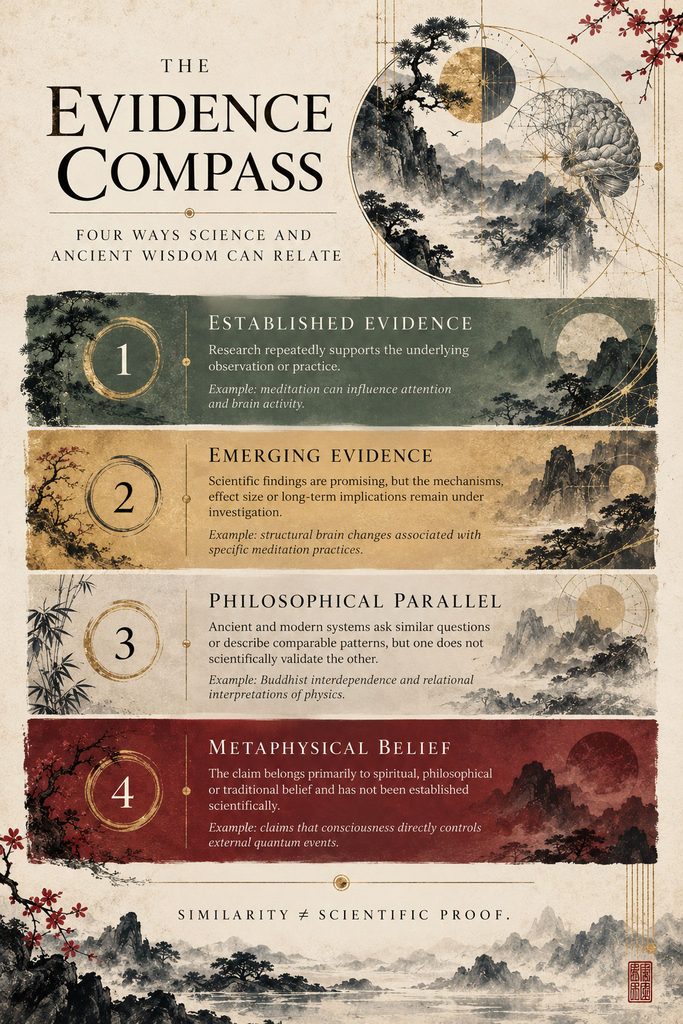
Science and ancient wisdom meet most convincingly when they describe the same human experiences from different directions: attention, perception, interdependence, bodily awareness and change. Neuroscience now provides measurable evidence for some contemplative practices. Quantum physics offers fascinating philosophical parallels. But those parallels are not proof that ancient mystics somehow knew modern physics.
That distinction matters.
When I was around twelve, I began sitting in Zen temples near Kyoto. I knew nothing about neural networks, brain imaging or the default mode network. I only knew that after sitting quietly for long enough, something changed. The noise inside me loosened. Breath became more noticeable. Thoughts still came, but they no longer seemed quite as solid as they had five minutes earlier.
Years later, studying philosophy and psychology and spending time in the United States, I started hearing very different language for experiences that felt strangely familiar. Neuroscientists talked about attention networks. Psychologists spoke about metacognition. Researchers studied the brain during meditation. Physicists questioned whether the classical picture of reality as a collection of separate, self-contained objects was sufficient.
For a while I became fascinated by every apparent connection. Then I became wary of them.
There is a seductive kind of spirituality that grabs a scientific word, usually quantum, wraps it around an ancient teaching and announces that modern physics has finally proved what mystics knew all along. I understand the attraction. I just don’t think we need to do it.
Ancient wisdom becomes more interesting, not less, when we stop forcing science to certify it.
Science has its methods. Contemplative traditions have theirs. Sometimes the findings meet in remarkable places. Sometimes they simply rhyme.
And occasionally, the rhyme is enough to make you stop and listen.
The meeting is no longer a fringe conversation either. Meditation has moved far beyond monasteries and retreat centres. According to the US National Center for Complementary and Integrative Health, the proportion of American adults practising meditation rose from 7.5% in 2002 to 17.3% in 2022, making it the most commonly used of seven complementary health approaches measured in that survey.
So what does the evidence actually show?
Where Ancient Wisdom and Modern Science Actually Meet
| Ancient idea or practice | Modern scientific lens | What the evidence allows us to say |
|---|---|---|
| Buddhist present-moment awareness | Attention research and Default Mode Network studies | Meditation is associated with measurable differences in attention, mind-wandering and brain activity. |
| Buddhist interdependence | Relational quantum mechanics | There is an interesting philosophical resemblance; quantum physics does not prove Buddhist doctrine. |
| Taoist body awareness | Interoception and body-brain communication | Neuroscience strongly supports the importance of internal bodily sensing. |
| Hermetic microcosm and macrocosm | Systems thinking and patterns across scales | A useful conceptual comparison rather than a direct scientific equivalence. |
| Hindu cyclical cosmology | Cyclic cosmological models | Both contain cosmic cycles, but modern cosmology does not verify Hindu cosmology. |
| Long-term contemplative training | Neuroplasticity | Repeated mental practice can be associated with measurable functional and structural brain changes. |
That last column is the important one.
There is enough genuine wonder here. We don’t need to manufacture more.
The Historical Roots: Ancient Wisdom Was Never Completely Separate From Science
One of our modern habits is to look backwards and sort historical figures into neat boxes.
Scientist. Mystic. Philosopher. Alchemist. Theologian.
The people themselves were often far messier.
During the Renaissance, European thinkers rediscovered texts including the Corpus Hermeticum, the Chaldean Oracles, the Sibylline Oracles and the Orphic Hymns. These works became associated with the idea of prisca sapientia—roughly, an ancient or primordial wisdom containing truths about humanity, nature and the cosmos.
This wasn’t a minor curiosity tucked away from the development of science.
The ERC-funded VERITRACE research project is examining how this ancient-wisdom tradition influenced early modern natural philosophy. Its researchers note that figures including Nicolaus Copernicus, Johannes Kepler, Francis Bacon, Pierre Gassendi, Isaac Newton and Gottfried Wilhelm Leibniz engaged with this intellectual tradition. Importantly, the project is still asking what exactly these thinkers took from the texts and how much influence the tradition had.
That final point is worth keeping.
The exciting version of history says, “Newton discovered gravity because he understood Hermetic secrets.”
The responsible version is more interesting: Newton inhabited an intellectual world in which theology, natural philosophy, mathematics, chronology and alchemy did not sit behind the clean walls we have built between them today.
Isaac Newton Was Far Stranger Than the Textbook Version
Most of us meet Isaac Newton through gravity, optics and the laws of motion.
The surviving papers tell a larger story.
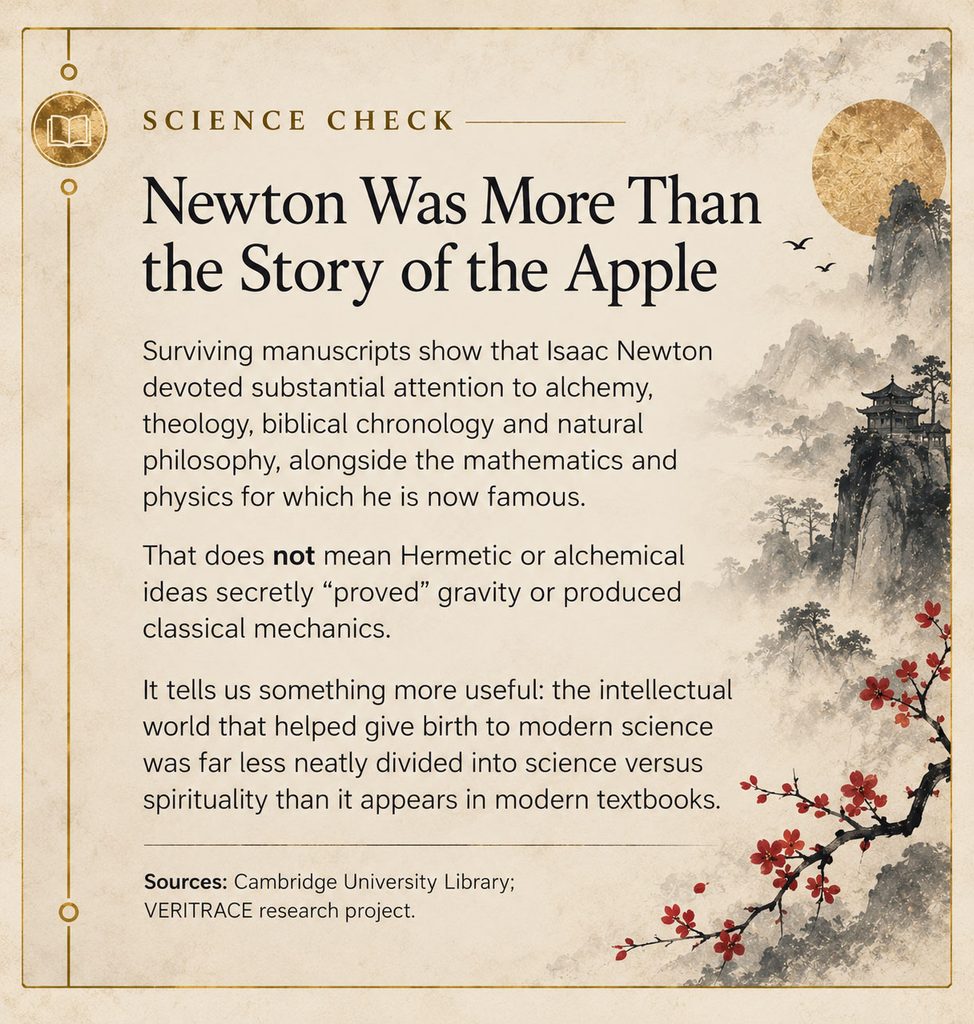
Cambridge University Library notes that substantial portions of Newton’s manuscripts concerned alchemy, theology and chronology, alongside the mathematical and scientific material for which he became famous. Some of his chemical and alchemical experimental notes survive in the Cambridge collections today.
This doesn’t mean alchemy secretly was quantum physics, or that mystical study handed Newton the equations of classical mechanics.
It tells us something subtler.
The mind that helped build modern physics did not live inside our modern definition of what a scientist was supposed to think about.
I find that strangely freeing.
My father taught calligraphy, and one of the first things he taught me was that a finished brushstroke hides the movement that produced it. Look only at the mark on the paper and you miss the wrist, pressure, breath, hesitation and years of repetition behind it.
History can be like that.
We see Newton’s equations—the finished strokes—and forget the complicated mind holding the brush.
What Prisca Sapientia Really Adds to the Conversation
The importance of perennial wisdom isn’t that somebody in antiquity had secretly written down the Standard Model of particle physics.
They hadn’t.
Its importance is that human beings have been asking certain questions for a very long time.
What is reality made of?
Are things truly separate?
Can appearances deceive us?
What is consciousness?
Does nature contain an underlying order?
What changes when the observer changes?
Science transformed our ability to investigate those questions. Ancient philosophical and contemplative systems approached them through reason, introspection, symbolism and lived practice.
Different tools. Sometimes surprisingly familiar territory.
Quantum Physics and Ancient Wisdom: Similar Questions, Different Languages
Quantum mechanics is where conversations about science and ancient wisdom become both fascinating and dangerous.
Fascinating because quantum physics genuinely overturned the comfortable mechanical picture of reality inherited from classical physics.
Dangerous because almost anything can be made to sound scientific after the word “quantum” has been placed in front of it.
Quantum healing. Quantum manifestation. Quantum consciousness. Quantum abundance.
Sometimes the word is doing rather more work than the physics.
David Bohm’s Implicate Order: Is Reality More Whole Than It Appears?
Physicist David Bohm offered one of the more thoughtful bridges between physics, philosophy and questions of wholeness.
Bohm distinguished between what he called the explicate order, the unfolded world of apparently separate things we encounter, and the implicate order, a deeper enfolded order from which those appearances emerge.
One of his favourite illustrations was the hologram. Information about the whole image is distributed through the holographic pattern rather than sitting neatly in isolated pieces. Bohm used ideas like this to question whether fragmentation was truly fundamental to nature.
You can see why spiritual thinkers were interested.
Hermetic traditions contain the famous correspondence between microcosm and macrocosm, popularly shortened to as above, so below. Buddhist and Taoist philosophies also resist the idea that reality is simply a warehouse full of permanently separate objects.
There is a resonance here.
But resonance is the right word.
Bohm’s implicate order is a physical and philosophical proposal. The Hermetic principle is a metaphysical doctrine. Their similarity can sharpen a question; it cannot erase the difference between them.
Bohm himself was unusually open to that conversation. In his later writing he explicitly discussed how his physical ideas might relate to religious approaches to life.
I appreciate that openness because it avoids two equally unhelpful positions: “science has explained spirituality” and “science has nothing to say to spirituality.”
There is a wide, fertile ground between those two extremes.
Relational Quantum Mechanics and Buddhist Interdependence
This is one of the most intriguing comparisons in the whole subject.
Relational quantum mechanics, introduced by physicist Carlo Rovelli in 1996, proposes that the values of physical quantities are relational rather than necessarily absolute properties possessed by an object independently of other physical systems.
The Stanford Encyclopedia of Philosophy describes RQM as a serious interpretation of quantum mechanics that asks us to reconsider the conceptual framework through which we think about physical reality.
Buddhist philosophy has spent centuries examining a very different but superficially similar idea: dependent origination.
Things arise through conditions and relationships. Nothing possesses the completely independent, permanent essence the mind habitually assigns to it.
That resemblance has led Rovelli himself into discussions with Buddhist scholars. Science & Wisdom LIVE, a project connected with the Jamyang London Buddhist Centre and Mind & Life Europe, has hosted a dialogue between Rovelli and Geshe Tenzin Namdak specifically about consciousness, Buddhist philosophy and modern physics.
This is worth taking seriously.
It is not, however, the same as saying that quantum mechanics has demonstrated dependent origination in a laboratory.
The “observer” in quantum mechanics does not automatically mean a human consciousness watching reality into existence. In relational quantum mechanics especially, the relation can be between physical systems.
That may sound like a small technical distinction. It isn’t.
It is the difference between thoughtful comparison and spiritual fan fiction.
Researchers studying the Buddhism-science dialogue have made the same warning: apparent parallels can become misleading when different schools of Buddhist philosophy and competing interpretations of quantum mechanics are flattened into a single convenient story.
For me, that doesn’t weaken the connection. It cleans it.
Maya, Matter and the Strange Loss of Solidity
Another comparison often made between Eastern philosophy and modern physics concerns Maya.
The concept is richer than the casual translation “everything is an illusion”, but it points us towards a recurring Indian philosophical concern: the reality we ordinarily perceive may not reveal things as they ultimately are.
Modern physics gives us its own reason to distrust common sense.
A wooden table feels perfectly solid beneath your hand. At ordinary human scale, describing it as solid is useful and accurate enough. Go deeper, though, and the picture changes.
CERN’s description of quantum field theory explains that fundamental quantum fields fill the universe and that particles can be represented as excitations or waves in those fields. CERN teaching material also notes that more than 99.99% of an atom’s volume can be described as empty space when comparing the scale of an atom with its nucleus.
Does that mean your table isn’t real?
Try walking into it in the dark and decide.
The lesson is not that matter is imaginary. It is that human-scale appearance is not the full physical description of matter.
That is a much more interesting idea.
A spiritual teacher may ask whether the world we perceive is filtered through concepts, habits and identity. A physicist may ask what underlying structures produce the stable appearance of matter.
Those are not identical questions.
Yet both unsettle the same instinct: what I immediately perceive must be the whole story.
Cyclical Cosmology: Did Ancient India Predict the Big Crunch?
Ancient Hindu cosmology contains enormous cycles of creation, dissolution and renewed manifestation. The scale of those stories is one reason modern readers often compare them with cosmological theories of an expanding and contracting universe.
There really have been scientific models involving cosmic contraction or a Big Crunch.
NASA still presents a Big Crunch as one theoretical possible fate of the universe if the behaviour of dark energy were to change in the required way. Other possibilities include continued expansion and a Big Rip.
That’s fascinating.
It is not evidence that ancient cosmologists scientifically predicted the fate of the universe.
The similarity lies in the imagination of cosmic cycles. Modern cosmology reaches its models through observation, mathematics and physical theory. Hindu cosmological cycles arise from a religious and philosophical framework with a different purpose.
I would rather let those two visions stand beside one another than force one to become the footnote of the other.
Sometimes an ancient image can enlarge our imagination without needing to become a scientific forecast.

Neuroscience and Ancient Contemplative Practice: Where the Evidence Gets Stronger
If quantum physics gives us philosophical parallels, neuroscience gives us firmer experimental ground.
This is where I think the conversation becomes especially valuable.
For centuries, meditation traditions have claimed that repeated mental practice changes the practitioner. That claim is no longer only philosophical.
The details are still being worked out, but the broad idea—that repeated mental training is associated with measurable changes in brain function—is entirely compatible with what neuroscience now knows about plasticity.
Neuroplasticity and Mindfulness: Practice Leaves a Trace
Neuroplasticity is the brain’s capacity to change its functional organisation and, under some conditions, its structure in response to experience.
That may sound clinical. In practice, it means repetition matters.
What you repeatedly attend to is not psychologically neutral.
A well-known controlled longitudinal study led by Britta Hölzel examined meditation-naïve participants before and after an eight-week Mindfulness-Based Stress Reduction programme. The study included 16 people in the MBSR group and 17 controls. Researchers reported increased grey-matter concentration in the left hippocampus, with other changes appearing in regions including the posterior cingulate cortex and temporoparietal junction.
It was a small study, and we should treat it as such. One MRI experiment with a few dozen people does not prove that meditation completely “rewires your brain” after eight weeks, a phrase I see far too often online.
Still, it adds to a much larger body of research suggesting that contemplative practice isn’t merely an idea you hold.
You practise with a nervous system.
That system learns.
This is where something my father taught me about calligraphy returned years later with a different meaning.
When I was young, repeating the same brushstroke felt pointless. Surely once I understood the movement, I knew it?
No.
Understanding the stroke and having the stroke inside your body were two different things.
Meditation is similar.
You can understand presence beautifully and remain almost incapable of returning to it when somebody irritates you.
Practice is where the philosophy reaches the nervous system.
The Default Mode Network and the Noisy Self

One of the most interesting areas in meditation research involves the default mode network, or DMN.
The DMN is a network of brain regions associated with forms of internally directed thought, including self-referential processing and mind-wandering. Two important nodes are the medial prefrontal cortex and posterior cingulate cortex.
A 2011 study from Yale compared experienced meditators with meditation-naïve controls while they practised concentration, loving-kindness and choiceless-awareness meditation. Across the meditation conditions, researchers found relatively less activity in key DMN regions among experienced meditators. They also found different patterns of connectivity involving regions associated with self-monitoring and cognitive control.
A later study also found reduced default-mode activity during meditation compared with an active cognitive task, strengthening the case that the effect was not simply “doing something instead of resting.”
This becomes even more interesting when placed beside what we know about wandering attention.
In a Harvard study involving 2,250 adults and around 250,000 experience samples, participants reported thinking about something other than what they were currently doing 46.9% of the time. Greater mind-wandering was associated with lower reported happiness.
Nearly half.
That figure stayed with me when I first came across it.
Half a waking life can disappear into somewhere that isn’t here.
The Buddha did not have an fMRI scanner. Zen monks did not know what a posterior cingulate cortex was. Yet contemplative traditions noticed, through relentless observation, that an untrained mind has a habit of leaving the present and becoming absorbed in remembered, imagined and self-created worlds.
Science hasn’t proved enlightenment.
It has, however, found something measurable where contemplatives had been pointing for a very long time.
Meditation Research Is Promising, but It Isn’t Magic
This is another place where spiritual writing often gets carried away.
Meditation is powerful. It is not a cure-all.
A 2014 review of 47 trials involving 3,515 participants found moderate evidence that mindfulness meditation programmes could improve anxiety and depression. More recent summaries from the NCCIH report promising evidence in several areas, while repeatedly warning that study quality, intervention type and long-term effects vary.
There can also be unwanted experiences.
A review covering 83 studies and 6,703 participants found that roughly 8% reported a negative effect associated with meditation, most commonly anxiety or depression.
I think spiritual communities need to talk about that more.
More meditation is not automatically better. Silence can be nourishing, but it can also bring difficult material closer to the surface. Good practice includes discernment, pacing and knowing when spiritual tools are not substitutes for appropriate medical or psychological care.
That doesn’t make meditation less sacred.
It makes us more responsible with it.
Taoism, Embodied Cognition and the Intelligence of the Body
Western thought has often treated the mind as though it were a little commander sitting somewhere inside the skull.
The body became transport.
Taoist practice never made that separation quite so cleanly.
Breath, posture, sensation, movement, attention and emotion belong to one living process. In Chinese thought, even the concept of xīn can blur the neat English distinction between “heart” and “mind”.
Modern neuroscience is arriving at its own language for this body-mind conversation.
One important term is interoception: the nervous system’s sensing of signals originating inside the body.
A 2024 review in the Annual Review of Physiology describes interoception as vital to homeostasis and notes that internal signals influence autonomic, cognitive and behavioural functions. These signals include mechanical, chemical, hormonal and pathological information travelling through specialised cells, nerves and brain pathways.
A separate 2024 review describes bodily self-awareness as deeply entwined with interoceptive networks and ongoing communication between visceral activity and large-scale neural systems.
Ancient Taoists didn’t discover the vagus nerve in the modern anatomical sense.
But they did take seriously something modern people routinely forget:
you do not experience life from the neck up.
Anxiety has a pulse.
Grief has weight.
Embarrassment heats the skin.
Fear changes breathing before you have finished explaining to yourself what you’re afraid of.
Spend ten minutes arguing with someone, then try to “think positively” while your jaw is clenched, shoulders are raised and breath is trapped high in your chest. You quickly discover that consciousness isn’t a speech floating above the body.
This is why embodied spiritual practice matters.
The body isn’t getting in the way of awakening.
It is where much of the work takes place.
From Ancient Insight to Daily Life: Seven Principles Worth Testing
This is where the subject either becomes useful or collapses into an interesting collection of ideas.
A modern attempt to bring Taoist thought into conversation with neuropsychology comes from neuropsychologist Dr Aldrich Chan, whose Seven Principles of Nature groups the ideas under the acronym CPR WEST: creativity, process, relationship, wholeness, equilibrium, spontaneity and transformation. Chan presents this as a contemporary synthesis informed by Daoist philosophy and neuroscience, rather than as an ancient Taoist formula handed down unchanged through history.

I like the framework because you can test it without believing anything supernatural.
- Creativity: Reality changes. Your response can change with it. Notice when certainty has become a cage rather than a source of stability.
- Process: Stop treating every stage of life as an obstacle between you and some imagined destination. There is no separate place where life finally begins.
- Relationship: Pay attention to what happens to your nervous system around different people, environments and rhythms. We affect one another more deeply than our individualistic culture likes to admit.
- Wholeness: The parts of yourself you reject do not disappear. Shadow work begins when you stop pretending that only your pleasant qualities belong to you.
- Equilibrium: Balance is not standing perfectly still. A living body is always adjusting. Psychological balance works much the same way.
- Spontaneity: Not every wise decision arrives after another hour of analysis. Skilled intuition can emerge from experience that has sunk beneath deliberate thought.
- Transformation: Change is not an interruption in the natural order. It is the natural order.
There is a familiar Taoist flavour in all of this: less domination, more participation.
That has taken me years to understand.
I used to approach meditation the way an ambitious student approaches an exam. Sit correctly. Breathe correctly. Get somewhere.
Predictably, the mind turned stillness into another performance.
The shift came when I stopped asking, “Am I doing this well?” and began noticing what was actually happening.
Pressure behind the eyes.
A shallow inhale.
A thought rehearsing tomorrow.
Birdsong outside.
Then another breath.
Nothing spectacular happened. That was rather the point.
A Simple Way to Practise the Meeting of Science and Ancient Wisdom
You can try this without incense, special clothing or any belief about energy.
Sit somewhere comfortable for five minutes.
For the first minute, notice bodily sensation before trying to change anything. Where is there pressure, warmth, tension, movement?
Then notice breathing.
After that, watch thoughts arrive. Instead of finishing every thought, see whether you can recognise it simply as mental activity.
When attention wanders, return to one physical sensation.
That’s all.
What makes the exercise interesting is the number of traditions meeting inside something so ordinary. A Buddhist may describe returning from identification with thought. A Taoist may emphasise coming back into the living body. A neuroscientist might talk about attention, interoception and self-referential processing.
You don’t need to decide which language is the winner.
Do the practice.
See what you notice.
Beyond the Cartesian Divide: When Psychology Became Interested in the Sacred Again
The meeting of ancient wisdom and modern psychology didn’t begin with Instagram neuroscience.
In the twentieth century, thinkers within transpersonal psychology tried to widen psychological inquiry beyond behaviour and pathology to include mystical experience, altered states, spiritual practice and questions of meaning.
Psychiatrist Stanislav Grof became one of the best-known figures in that movement. In 1984 he edited Ancient Wisdom and Modern Science, a collection based on material from the International Transpersonal Association that brought together discussions of Buddhism, meditation, kundalini, psychology, consciousness and new scientific paradigms.
Some of the claims made within transpersonal circles remain controversial, and they shouldn’t be granted scientific status merely because they use psychological language.
Still, the movement raised a question mainstream psychology increasingly finds difficult to ignore:
What do we do with experiences people describe as sacred, self-transcendent or mystical?
Dismiss them because they are subjective?
Treat them only as symptoms?
Accept every interpretation attached to them?
None of those options seems satisfactory.
A mature science of consciousness may need to study subjective experience seriously without abandoning critical standards.
Interestingly, peer-reviewed work on the dialogue between Buddhism and neuroscience has made a similar argument: neuroscience has become increasingly willing to study consciousness, while contemplative traditions may offer disciplined first-person methods and conceptual frameworks that widen the questions being asked.
That is the meeting I find most promising.
Not science kneeling before spirituality.
Not spirituality dressing itself in a lab coat.
Two different ways of knowing sitting at the same table.
Frequently Asked Questions About Science and Ancient Wisdom
Does modern quantum physics support ancient spiritual philosophies?
Quantum physics has produced concepts that can be fruitfully compared with ancient philosophies, including relationality, uncertainty and questions about the classical idea of independently existing objects. Those similarities do not scientifically prove Buddhism, Hermeticism, Hinduism or other spiritual systems.
Relational quantum mechanics, for example, treats physical properties relationally, which invites comparison with Buddhist interdependence. The comparison is philosophically interesting, but the traditions use different methods and make different kinds of claims.
What is prisca sapientia?
Prisca sapientia means “ancient wisdom” and refers to the Renaissance belief that very old religious and philosophical traditions contained a primordial body of truth about God, humanity and the cosmos.
Current research through the ERC-funded VERITRACE project is examining how texts associated with this tradition influenced early modern natural philosophers including Copernicus, Kepler, Bacon, Newton and Leibniz.
How does meditation affect the default mode network?
Several brain-imaging studies have found differences in default mode network activity and connectivity during meditation, particularly among experienced meditators. The DMN is involved in processes including self-referential thought and mind-wandering.
A Yale study found relatively reduced activity in major DMN nodes during three types of meditation in experienced practitioners compared with non-meditating controls. This is one possible neural mechanism behind reductions in mind-wandering, although meditation affects multiple brain systems and should not be reduced to a single network.
Does meditation physically change the brain?
Research suggests that repeated meditation may be associated with both functional and structural brain changes, but the size and meaning of those changes should not be exaggerated.
An eight-week MBSR study found changes in grey-matter concentration in several regions, including the hippocampus, but the experiment involved only 33 people across intervention and control groups. Larger bodies of research support neuroplastic effects of experience generally, while the exact long-term effects of specific meditation practices remain an active area of study.
Did ancient spiritual traditions already understand quantum physics?
No—not in the scientific meaning of the phrase.
Ancient traditions developed sophisticated philosophies of perception, causality, change, consciousness and relationship. Some of those ideas bear striking conceptual similarities to questions raised by modern physics. Quantum mechanics, however, depends on mathematics, experiments and physical predictions unavailable to ancient thinkers.
Saying the traditions sometimes anticipated a way of questioning reality is far more defensible than saying they already possessed quantum theory.
How do ancient Eastern traditions view time differently from modern physics?
Many Indian and Buddhist traditions reject the idea that human experience should be understood only through a simple linear story stretching from past to future. Hindu cosmologies can include enormous recurring cycles, while Buddhist practice repeatedly returns attention to impermanence and present experience.
Modern physics also complicates everyday ideas of time, though for entirely different reasons. Relativity, cosmology and quantum theory emerge from mathematical and experimental work rather than contemplative doctrine. Similarity in theme should therefore be treated as a prompt for comparison, not evidence that the systems are interchangeable.
Where Science and Ancient Wisdom Really Meet
The most interesting part of this conversation is not proving that ancient traditions somehow “knew” modern science. It is noticing where centuries of contemplation, observation and lived practice overlap with what researchers are now able to measure. Meditation, embodiment, attention, perception and the nature of reality all sit in that shared territory.
I have come to value that middle ground more than either extreme. Science gives us methods for testing claims and separating evidence from wishful thinking, while ancient traditions often ask questions that science is only beginning to explore in depth. One does not need to validate the other for both to be useful.
Perhaps that is the real meeting point: not agreement, but curiosity. When we can respect the evidence without stripping away mystery, and explore ancient wisdom without turning every spiritual idea into a scientific fact, the conversation becomes far more interesting.
There is still a great deal we do not understand about consciousness, the mind and reality itself. That is not a weakness in the discussion. It is the reason to keep looking.




Add comment